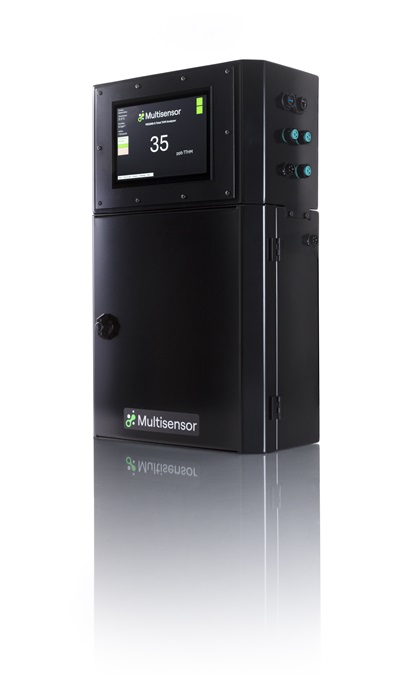
The MS2000-S is a highly sensitive online Total Trihalomethane (THM) analyser which helps water treatment operators optimise their process to meet local regulations. The MS2000-S uses a contactless measurement technique that greatly reduces maintenance requirements. Furthermore, the instrument does not require reagents, minimising ongoing running costs.
Regulations limiting the levels of Disinfection By-Products (DBPs) such as Trihalomethanes (THMs) in drinking water have made the ability to measure THM levels throughout the distribution network essential. Multisensor’s MS2000-S provides that capability efficiently and accurately.
Measuring Total THMs with high accuracy, the MS2000-S provides the confidence needed in a process control instrument, which is vital for meeting regulatory and legal requirements.
Applications
- Analyse THMs post-treatment
- Monitor THMs in the distribution network
- Monitor THMs post-chlorination for enhanced process control
Features and Benefits
- No sensor contact with water: low maintenance, no sensor cleaning
- No reagents: low running costs
- Most cost-effective solution
- High sensitivity: ideal for potable water
- Alarms to SCADA and other communication interfaces
For more information on the principle of operation, see the FAQs tab.
THMs and Health Risks
Trihalomethanes (THMs) are a group of four chemicals formed along with other disinfection by-products when chlorine or other disinfectants used to control microbial contaminants in drinking water react with naturally occurring organic and inorganic matter.
The THMs are Chloroform (CHCl3), Bromodichloromethane (CHCl2Br), Dibromochloromethane (CHClBr2), and Bromoform (CHBr3). National regulatory bodies set limits for THM levels in drinking water, typically monitored regularly at the tap.
They are recognised as potential carcinogens. Chloroform is the most common in most water systems, while Dibromochloromethane presents the highest cancer risk (0.6 µg/l for a 10-6 increased risk), followed by Bromoform (4 µg/l) and Chloroform (6 µg/l).
THM levels tend to increase with pH, temperature, time, and the concentration of "precursors"—organic materials that react with chlorine to form THMs. Reducing chlorination prior to filtration and minimising precursors helps lower THM formation.
For example, the US EPA recommends removing precursors via "enhanced coagulation" as the best available technology for THM control. This involves optimising the filtration process, adjusting pH, and increasing coagulant feed rates to maximise precursor removal.
 The principle of operation of the MS2000-S THM Monitor is based on measuring headspace gases from a sample tank containing the water to be monitored.